AI & Owning a Niche
AI is arriving in places nobody monitors yet — like a drawer of screws — and how it got there.

Start owning a niche
Defined: A niche is a problem only you are close enough to notice. The squeaky door hinge of your life. Owning it means you build the fix yourself: hyper-personalized, hyper-scaled-down, customized to your life and potentially useless to anyone else except you. That used to be a luxury of time and cost-benefit analysis. It isn't anymore.
All our lives, making a square peg fit in a round hole has been an adaptation that required a lot of intricate steps:
- Ideation (what to do about it)
- Measurement (how to fix it)
- Designing
- (Likely) Bridging the quirks
There's a lot of this going on in the tech world now with AI redesigning and rebuilding all the round holes. AI has already changed how my job works - not will change, literally has changed already. I think folks have talked at length about that though, so I want to focus on the opportunity which are those niches.
- I'll ground this with examples in the trials and tribulations I have had creating 3D models for my 3D printing hobby
- I'll cover where I resorted to using "the thing" called AI
- And I'll end with the fact that - spoilers - it worked better than I thought it ever could.
Table of Contents:
- "I live under a rock, what has been happening in tech?"
- What it means to own a niche
- My Take: outside of tech
1. "I live under a rock, what has been happening in tech"
As an industry, we have shoved AI down everyone's throat in 20,000 different ways. AI tooling is now embedded everywhere - everything is AI, everything has to be AI, and AI will revolutionize the job and/or you won't have the job anymore and/or don't worry about that because... something something universal basic income. Living in that smog, it makes sense why people are annoyed, afraid, or pessimistic about AI.
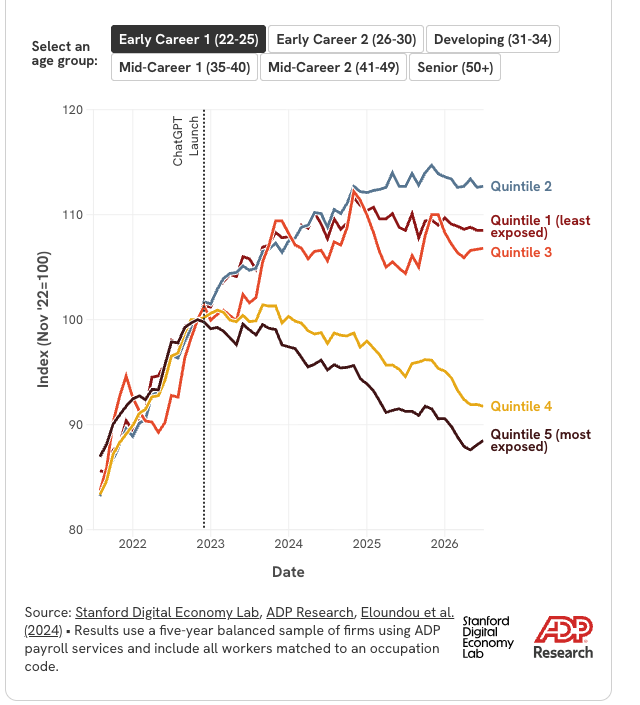
The most popular recent study on this comes from Stanford's Canaries in the Coal Mine (Brynjolfsson, Chandar and Chen; the August 2026 revision, on payroll data through June 2026). Employment of 22-to-25-year-olds in the most AI-exposed occupations is 19% below where it would be had it kept pace with their less-exposed peers. Workers in their late thirties and forties in the same occupations grew while those early in their careers died on the vine. It's an early warning signal that spread across the entire tech industry. While the studies so far have focused on hiring slowing - not firing - they are two sides of the same coin: we're hiring fewer people and then slowly burning everyone else out with AI slop.
2. What It Means to Own a Niche and Why Now
With everyone focused on part 1 - the tech industry impact - what about beyond? For those tech-adjacent or non-tech, I would push the warning of broader slow-downs and job impacts more aggressively. Like Stanford, Karpathy's visualization and aiexposure are resources tracking this slow burn. And it's happening bit by bit... not because necessarily just AI itself as a machine is doing it all, but because people like me are chomping at hyper-specialized, hyper-local niches that we could not tackle before - our niches.
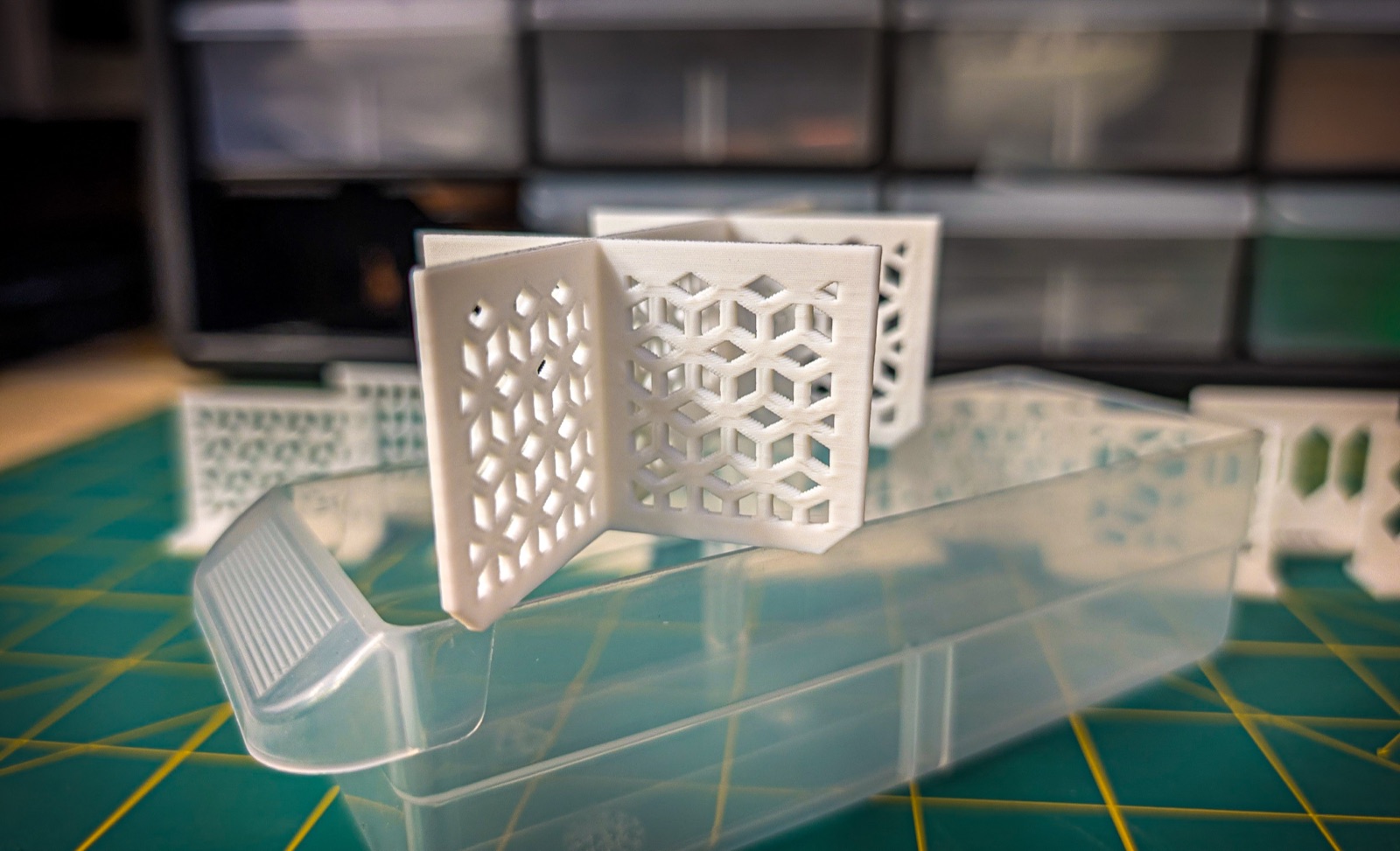
Let's take an example. I've had these storage cabinets in the garage that I have always been annoyed by because they are limited out-of-box with almost no customizations. The drawers are always either too big or too small, they don't have enough dividers included, they make me store 5 screws in a compartment that can hold 200.
Now you may be asking... How does AI come into the picture and why is that a threat? Previously, I would have:
- Left it alone
- Gone online and bought some organizers made by a machinist, CAD designer, manufacturer
- Found someone who could build something I sketched out by hand/measured. Instead, I did that all myself. And I'm not alone - everyone is doing that too, and some are making those micro-niche businesses out of it in two different ways.
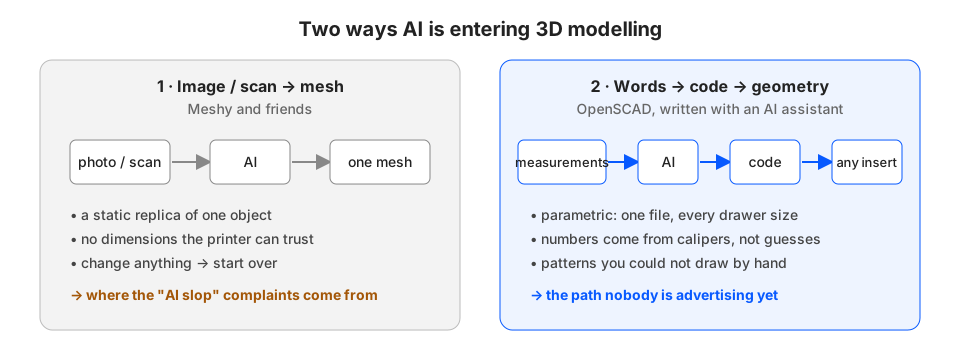
The first is the one everyone is complaining about - racing to the bottom with AI slop - in this example, doing mesh generation via image-to-model pipelines. People are taking 3D scans of things or even just providing flat 2D images and converting those into mesh "replicas", using services like Meshy. There's been a flood of complaints about this in the maker world as a result, with people just copying and pasting the output like college students writing essays today. It may not print well, it may not be set up correctly, it may not be modeled in a way that makes it easy to print. It's "vibe coded" and "AI slop" and has no humanity - the same slop from part 1, just printed: a first pass shipped as the product by someone never checking their answers.
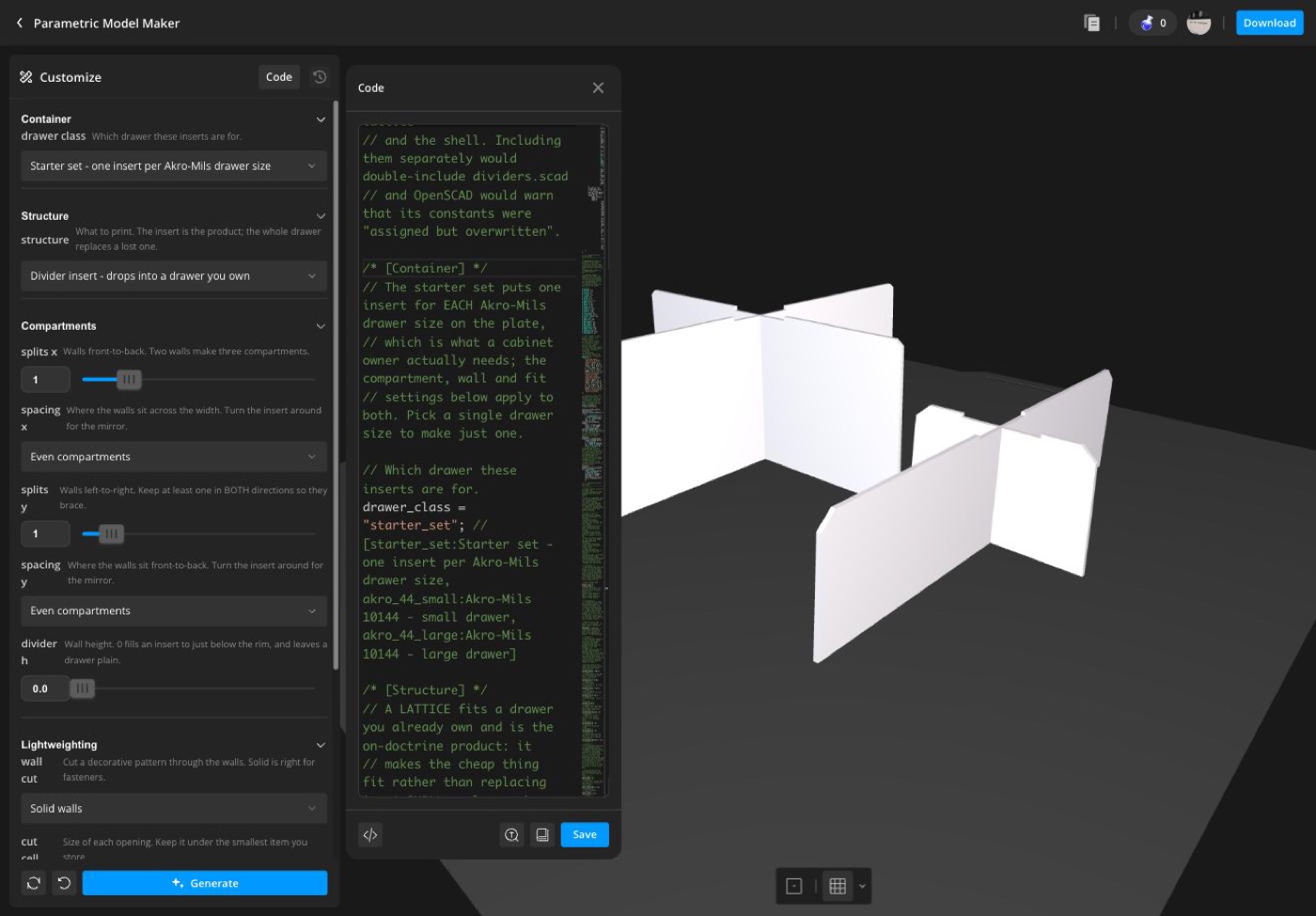
The second is AI-code-assisted CAD (computer-aided design) pipelines which I believe to be a hidden superpower no one is advertising yet. Using frameworks of geometry, vectors, and shapes via OpenSCAD, you model using math and equations. And we know AI is getting damn good at coding around that. What would take me weeks to learn using traditional CAD pipelines I got done using AI "drawing" in hours.
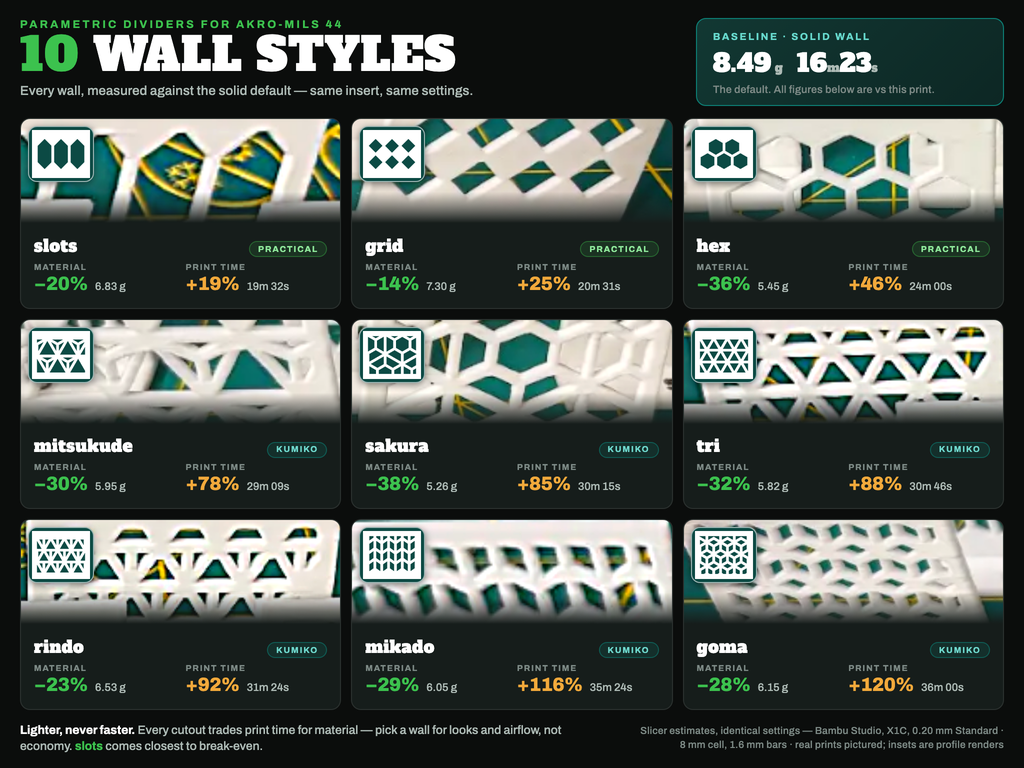
The wall-style patterns would be incredibly difficult to figure out by hand. Turning those into parametric designs allows a lot more variability and customizability. It's basically equations and math enabling modeling, which is very fast, efficient, and creates unique patterns at a scale you could not do by hand.
Going back to my framing up top:
-
Ideation. I could not imagine building the models and the designs that I am now churning out - selfishly for myself - around organization drawer inserts and miniature model making and fixing issues with compost bins in my house. These things are in a realm that I have never had the time to sit down and learn: CAD, Fusion 360, Blender, etc. And now I don't need to as AI speaks the language fluently already and I can focus on the ideas and designs.
-
Measurement. Compared to the AI slop, I ground my work with engineering truths. I took out digital calipers to take sub-millimeter measurements of all my organizer inserts.
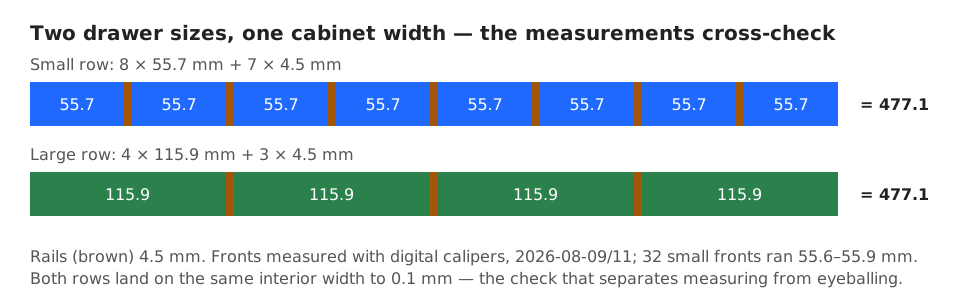
Programmatic checks balancing against real measurements, embedded in code guardrails, like 477.1mm cross-validating across all the maths. -
Designing. I drew hand schematics and labelled the math and boundaries and validations. The code may be AI assisted, but the foundations are grounded in real-life facts.
-
Bridging the Quirks. Out-of-the-box, my AI agents generated junk. They didn't understand the physicality yet. I added context, math, data models. I gave equations bounding boxes and guardrails, just like the eval systems used in my day-to-day as a Data Engineer to avoid "2 + 2 = 5" and "the number of r's in strawberry is NaN" - things that AI is known to hallucinate. So now it understands and can bridge that gap of digital to physical.
The Objection: When You're a Hammer
To a software engineer like me, everything is a coding problem. To a plumber, everything is a plumbing problem. To a hammer, everything is a nail. So the counter-argument for me may be, "am I seeing the world too much in code just because AI is exceptionally good at that right now?"
My retort: Code is cheap now. Look back at past computing revolutions: software changed factories by embedding robots. It changed logistics by tackling shortest path problems at scale. It changed design from paper to tablets. And now we are moving from scaled-up software to hyper-localized software that fits your specific skills and niche in minutes - not weeks. Agents translate what I want to do and what I need to do into functional software using words, not code. Every mom-and-pop shop has the ability to make the code now, at a degree that works, has enough quality that it at least is sustainable, and continues to improve every week.
That is the whole reason a niche is ownable now. The first path - relying on vibes - hands you a rough replica. The second - getting in the weeds - hands you the keys to your own personalized kingdom.
3. My Take: Handling This Inside and Out of Tech
I recently demonstrated this to my dad: I showed how some introductory agent prompts in software like Microsoft Excel got test results faster, forecasts finessed, using basic natural language in Copilot, upleveling the type of presentation work he was doing. A woodworker, like what I did with OpenSCAD and 3D printing, can accelerate how they design patterns and cuts for CNC (computer numerical control) machines. A nurse or doctor can remove the woes of data entry or insurance forms and focus on the "doing" of diagnosis and curing diseases.
HOWEVER - While an AI can translate desires to functional apps, it lacks domain expertise and guidance. There is still human physicality, exactness, taste, and art missing from all the output that an AI creates - a novelty that is still human, that is honestly easily discernible at least today. I bet given 5 articles you could tell the 4 that were AI written in seconds. The 3D model that has no internal supports. The logo that accidentally includes the watermark of the AI program that generated it.
If you have taste, judgment, a perspective, a purposeful thought, AI is an accelerator to prototyping what you need faster than ever before. You're looking at niches, annoying problems, and creating hyper-personalized, hyper-scaled-down applications that solve your problems and your needs in a way that is customized to your life. Instead of writing off the tools, you really should understand that so long as you are creating something worth building for yourself or for others, AI fortunately or unfortunately has arrived.
And I'm not alone. You're seeing niche startups by the dozens being spun up that fine-tune and customize these niches on behalf of small groups. They, and the agentic building behind them, make their primary love, their primary interest, or their primary job 2% easier with very little effort now. It's these people that the industry needs to be worried about. Not because any single individual will be big, but because none of them needs the "big product" anymore: the general-purpose tool sells to a million people who each use 5% of it... which is now a weekend's AI token budget.
Last Call: Building for a Purpose
AI empowerment can do a lot in the right hands - exactly what I did with 3D printing. But it only works if you provide the "taste" or "perspective" and domain expertise to guide it correctly.
The four steps, one more time:
- Ideation (what to do about it)
- Measurement (how to fix it)
- Designing
- (Likely) Bridging the quirks
You have people who are building for the sake of building, who are creating all these harnesses and tools, and they're able to generate some knowledge and some research papers or some posts. But what they aren't doing is building actually useful products. There's a lot of just moving numbers around and hoping people care. AI assistance and enhancement and power is meant for the people who will build for the niches. Remember: We should always build for a purpose, never just to build. Else you end up lost and defeated.
Find and own your niche.
Let me know at binaryhud@gmail.com - what is your squeaky door hinge? (Can be both figuratively or literally.) How will you take it on now, and will it be with or without AI?
Research Timeline
9 sources · 3 threads · Jun 2025–Aug 2026
Labour market
 Canaries in the Coal Mine (Stanford, Aug 2026)
An early warning signal that spread across the entire tech industry. It says hiring is slowing, not firing, but they are two sides of the same coin: if we hire less people and then slowly retention people out, same thing.
article AI Agents and the Entry-Level Ladder (Clara Shih, Platformer)
The same mental game I'm doing right now. AI empowerment can do a lot in the right hands — exactly what I did with 3D printing. But I am concerned about people who don't have that "taste" or "perspective" yet, like she has.
article US Job Market Visualizer (Karpathy)
Resources tracking this slow burn. And it's happening bit by bit.... with niches.
toolAI exposure risk scores by occupation (aiexposure.org)Resources tracking this slow burn. And it's happening bit by bit.... with niches.
toolMaker world
 MakerWorld Slop and the Ideas Barrier
There's been a flood of complaints about this in the maker world, with people just doing copy and paste into an LLM. It may not even print well, it may not be set up correctly, it may not be modeled in a way that makes it easy to print.
articleMedicine
 AI co-clinician (Google DeepMind, 2026)
Something I saw in passing in a different news article about DeepMind, filling the gap: there's been a lot of medical advances as well, with groups like Google DeepMind. A supplementary resource I've seen referenced in the industry.
article AMIE for differential diagnosis (Nature 2025)
Example of AI assistance giving superpowers to an ordinary individual.
articleAMIE: conversational diagnostic AI (Nature 2025)Google DeepMind has already claimed through their research that they are able to diagnose a bunch of things now with a degree of precision and recall compared to panels of doctors doing the same thing.
articleMedical AI with eyes, ears and a voice (2026)An argument for AI assistance versus AI only. They're still human in the loop, effectively.
article